FACT is delighted to present The Ghosts of Songs, the first exhibition devoted to the work of the Black Audio Film Collective, one of the most distinguished artist groups to emerge from Britain in recent years.

The Black Audio Film Collective (BAFC) was founded in 1982 by seven undergraduates in Sociology and Fine Art: John Akomfrah, Lina Gopaul, Avril Johnson, Reece Auguiste, Trevor Mathison, Edward George and Claire Johnson, who left in 1985 and was replaced by David Lawson. The Collective formally dissolved in 1998.
In many ways, BAFC were a unique group. Based initially in east, and later north, London, they produced internationally acclaimed, award winning slide-tape texts, films and videos; far more than any other artist group of the time. These explorations of belonging and intimacy combined a montage aesthetic with personal reflection to invent a new genre of moving image that challenged traditions of British documentary and drama, and profoundly influenced contemporary avant-garde film-makers and theorists.
In the 1980s, the collective were known as exceptional curators, whose film courses, seminar series and screening programmes brought avant-garde cinema, from India, Brazil, Cuba, Senegal and the USA, to London audiences for the first time. The desire to build an independent cineculture remained constant through the group’s numerous theoretical, critical, speculative and fictional writings. Unlike other moving image artists, the collective was not restricted to a single cultural context, but operated within and between the cultural spaces of the international film festival, the art gallery and broadcast television.
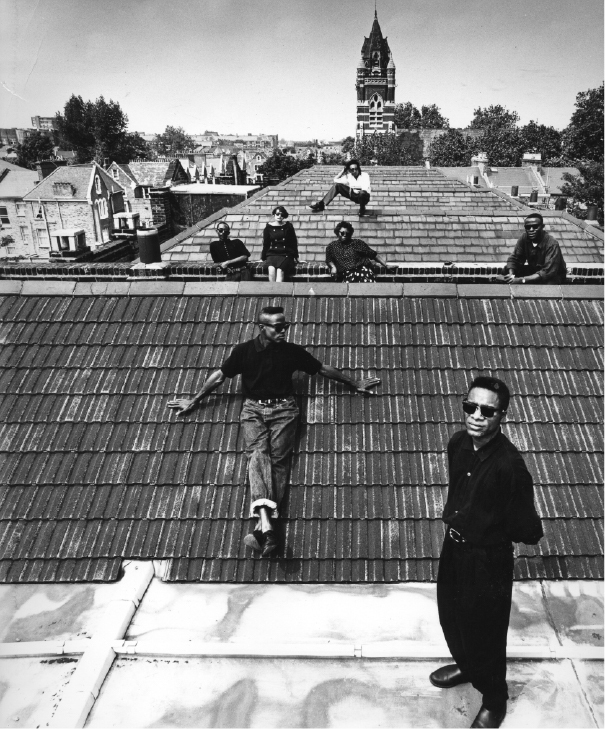
The Black Audio Film Collective, East London, 1989.
Front: David Lawson, Edward George.
Middle from left: Trevor Mathison, Lina Gopaul, Avril Johnson, John Akomfrah.
Back: Reece Auguiste.
Photography by Nigel Parry/© BAFC Trust.
The Ghosts of Songs invites audiences to engage with the Black Audio Film Collective through a series of chambers, installations, vitrines and digital interfaces, designed by the renowned architectural office Adjaye Associates, that allow a variety of encounters with the works.

Handsworth Songs, (1986). ©BAFC Trust.
Excavations
Gallery 1
It consists of three chambers designed by Adjaye Associates. The first chamber screens Signs of Empire, (1982 – 1984). The second chamber screens Handsworth Songs, (1986). The third chamber screens Twilight City, (1989). The exterior of each chamber is clad in black felt while the interiors are clad in coloured felt, relating to the lighting and emotional temperature of each film.

Seven Songs for Malcolm X, (1993). ©BAFC Trust.
Disenchantments
Gallery 2
The fourth chamber presents Seven Songs for Malcolm X, (1993). The fifth work is an installation entitled The Black Room, conceptualised by all of the artists of the Black Audio Film Collective and realised by John Akomfrah, David Lawson and Trevor Mathison as an ironic commentary on the idea of the retrospective.
The Black Room reworks the installation of the same name, designed by Trevor Mathison and Edward George, first presented for the group exhibition Mirage: Enigmas of Race, Difference and Desire at the Institute of Contemporary Art, London, 1996.
A series of Vitrines display other resources from BAFC, such as scripts, photographs, publicity materials and awards.

The Last Angel of History, (1995). ©BAFC Trust.
Interventions
The Media Lounge
Here visitors can access and re-work archival material through the Montage Mixer, view further film and video essays, and also browse the BAFC website.
The Ghosts of Songs has been conceptualised, curated and produced by Kodwo Eshun and Anjalika Sagar of The Otolith Group, which they founded in 2002. The Otolith Group is based in London and their work includes film, video, sound, text and curation, that examine different platforms for contemporary art practice. Their films and installations have featured in international exhibitions - including The Stedelijk Museum, Amsterdam, The Biennial of Contemporary Art of Seville, Spain, The Hayward Gallery and The Tate, London - and in 2006 The Otolith Group was the recipient of the Decibel Award from Arts Council England.

Film
John Akomfrah: Walking Tour and Film Screening
FACT
Join Nasra Elliott on a walking tour across the city, before an evening of films at FACT, by award-winning film director and British artist Sir John Akomfrah.
Resources
Supporters


Be inspired
Stay in touch
Join our mailing list and get the latest news about exhibitions, events, cinema highlights and opportunities sent to your inbox.
www.fact.co.uk/newsletter